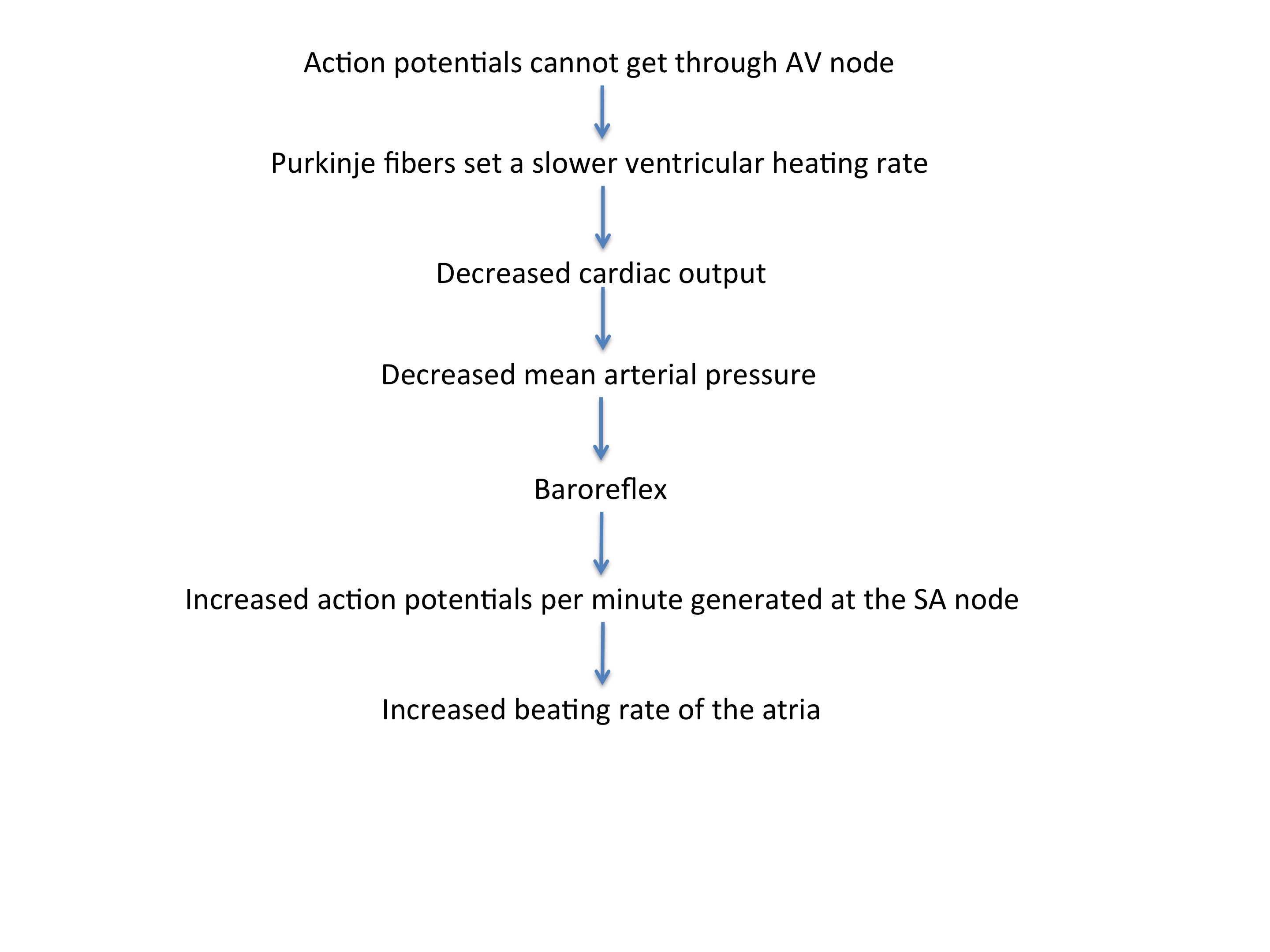
I’m getting this one a lot:
I have a question regarding #28 on one of your old exams: “If the AV node is destroyed then it is expected that…”I understand that “b) the ventricles will beat at a slower rate than normal” because their pace will be set by the purkinje fibers. But would “d) the atria will beat at the normal rate” not also be true because their contraction is dictated by the SA node and depolarization occurs independent and before the AV node?
Third degree heart block is, of course, what you get when the AV node can’t conduct action potentials to the ventricles.

Propagation of the action potential around the heart. The numbers are the time in seconds that it takes for the action potential to reach each region as it propagates away from the SA node.
Physiologically, the SA node, the AV node and some Purkinje fibers all will spontaneously depolarize. In this case, the action potentials aren’t getting to the ventricle. Without action potentials from the the SA node, the AV node takes over first and if that can’t take over due to disease, the Purkinje fibers do. The SA node set the pace when healthy because it depolarizeS fastest during phase 4. The action potential propagates away and stimulates the AV node and Purkinje fibers before they have has a chance to spontaneously throw an action potential on their own.
Therefore you may conclude that the SA node sets the pace at a higher rate than the AV node or Purkinje fibers would. If the SA node action potentials aren’t making it through, the AV node sets the pace at its own rate, which is slower or, if that’s not possible, the Purkinje fibers set an even slower rate.
Therefore: