
I’ve been asked quite a bit about the effect of class I anti-arrhythmic drugs. The three subclasses of these drugs have different effects but they share one thing in common: they block Na channels.
Na channels in ventricular and atrial cells much are like the Na channels in nerve and skeletal muscle. They media rapid depolarization once threshold is attained. Decreasing the number of available Na channels – in this case by blocking them – decreases action potential conduction velocity just like it did in these other tissues when we studied them previously.
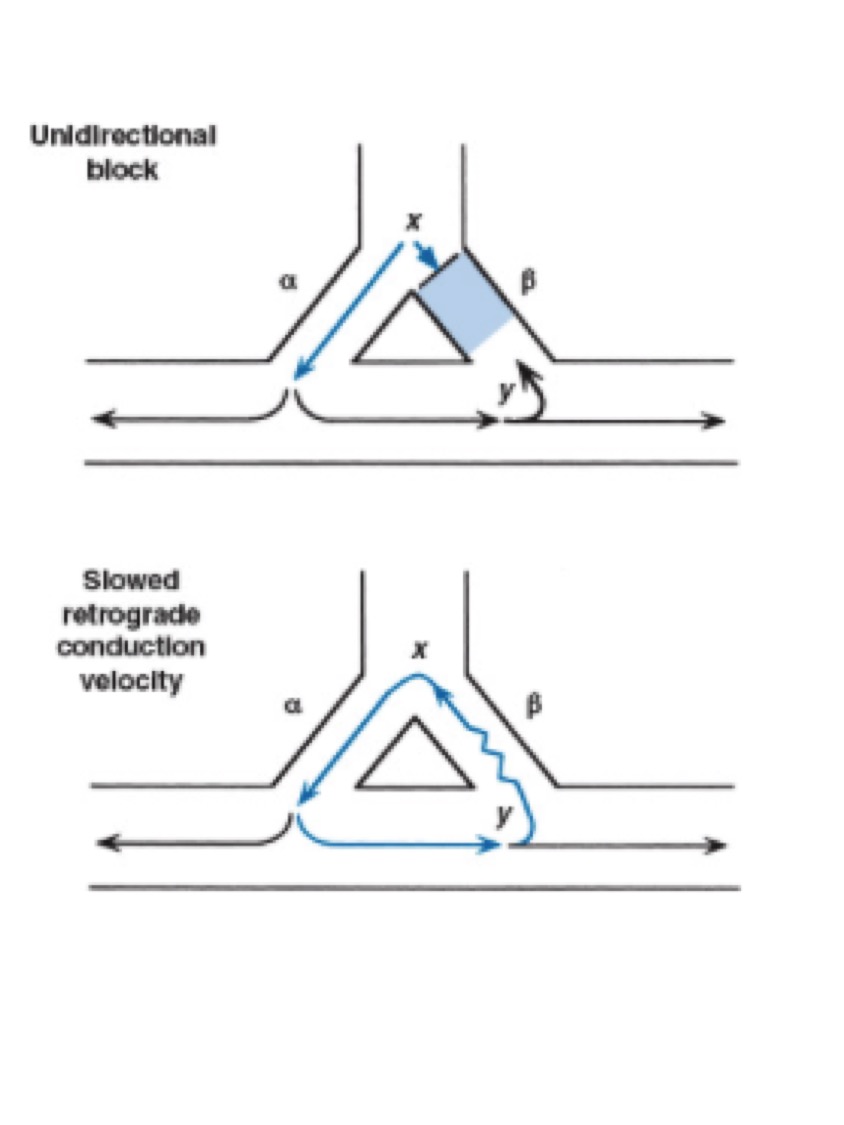 Consider the situation illustrated above. The unidirectional block is in the beta branch of the pathway (top figure). The action potential travels down the alpha branch (which is normal) and back up the beta branch (bottom figure). Note that though conduction is still allowed up the beta branch in a retrograde fashion, these cells are still abnormal and conduction may be slowed (bottom figure, squiggly line). If the action potential goes up the beta branch and reaches the alpha branch after the alpha branch has exited its refractory period, a re-entrant arrhythmia results.
With all of the class I anti-arrhythmic subclasses, the hope is that you will slow the conduction down in the already diseased beta branch enough to where it just completely stops and never gets back up to propagate back down the alpha branch. Some of the subclasses are more effective than others in this regard. And, of course, they all have different effects in addition to this. But they all do the above to at least some extent.