I’ve been asked this question several times now and it’s not unreasonable. I have some thoughts:
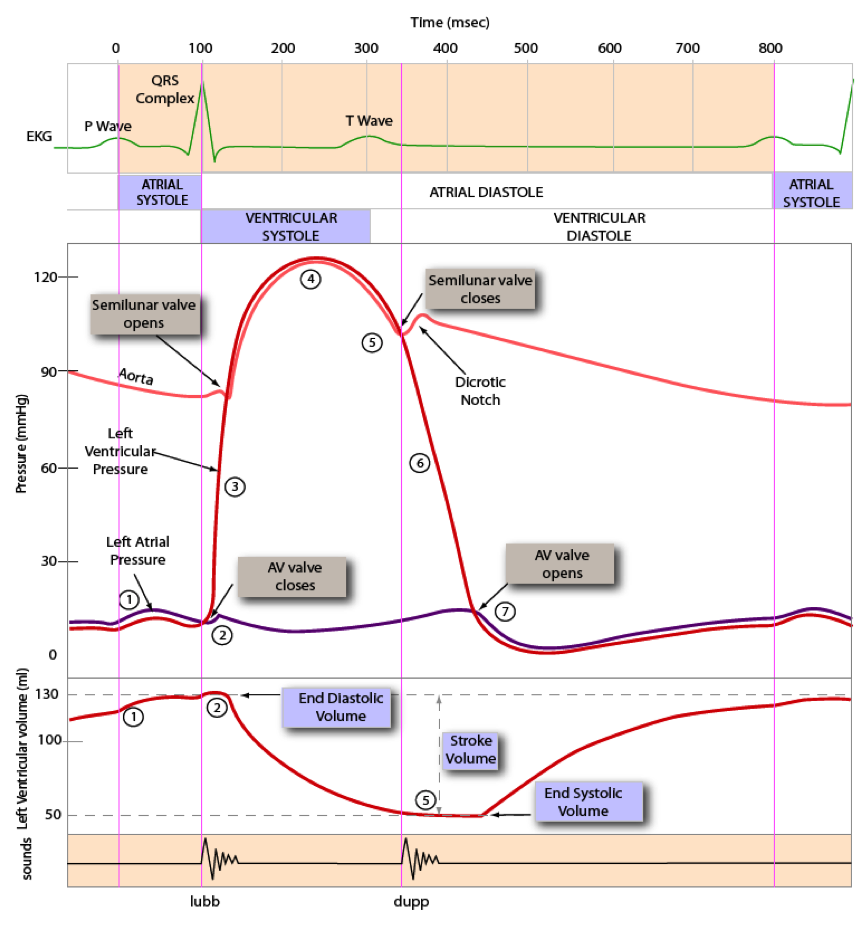
- This is kind of a grey area and it depends upon the context when asking the question. “Ventricular systole” when you are a physician doing a physical exam might be defined differently then when you are a scientist looking at the contractile properties of the cardiac muscle or an echo cardiologist watching the ventricle as it contracts and relaxes.
- Generally speaking everyone will agree that ventricular systole starts when the ventricular muscle starts to contract. Some may prefer to define it as when you see the QRS complex on an ECG, as technically that is when contraction begins to be initiated. If you are listening to heart sounds, you will likely define ventricular systole as beginning with the first heart sound. This is certainly almost simultaneous with when significant contraction begins to take place and pressure begins to build in the ventricle.
- Generally speaking every will agree that ventricular systole ends when the cardiac muscle stops contracting and begins to relax. If you are looking at the ECG, that’s when you see the T wave. If you are listening to heart sounds you will likely define ventricular systole as the period between S1 and S2 despite the fact that the T wave precedes S2 on the Wiggers diagram. You will also likely define a “holosystolic murmur” as one that you hear roughly between S1 and S2, e.g. when you would hear an stenotic aortic valve or when you would hear an insufficient mitral valve.
Wigger’s Diagram
- I get the impression that students think that we’re going to ask you “What is the period of systole defined by” and treat is as if it’s a black and white line on the exam and then scream, “Gotcha!” when you get it wrong because you chose to end it at the T wave when I chose to end it at S2. If that’s what you’re worried about, don’t. I’m not in the business of testing that kind of trivia and it should be clear what I’m looking for should I ask a question of this type. On the other hand, if I say that a patient has a holosystolic murmur, you should generally know what that means and draw conclusions based upon the physiology of the situation.