
I was asked to post an explanation for the following question by some students after today’s workshop. I was told that a number of students didn’t understand the answer. The question is found at the end of my Growth Self-Study:
8. A subject receives an IV infusion of parathyroid hormone (PTH) starting on day 2 of a study and continuing through day 5. Plasma [Ca+2] increases from day 2 through day 5 because PTH acts directly on:
a. bone to release calcium into the circulation
b. enterocytes to increase calcium absorption
c. the kidney to increase phosphate reabsorption
d. the parafollicular cells to decrease the secretion of calcitonin
e. none of the above; PTH acts very slowly and no significant change would occur within 5 days
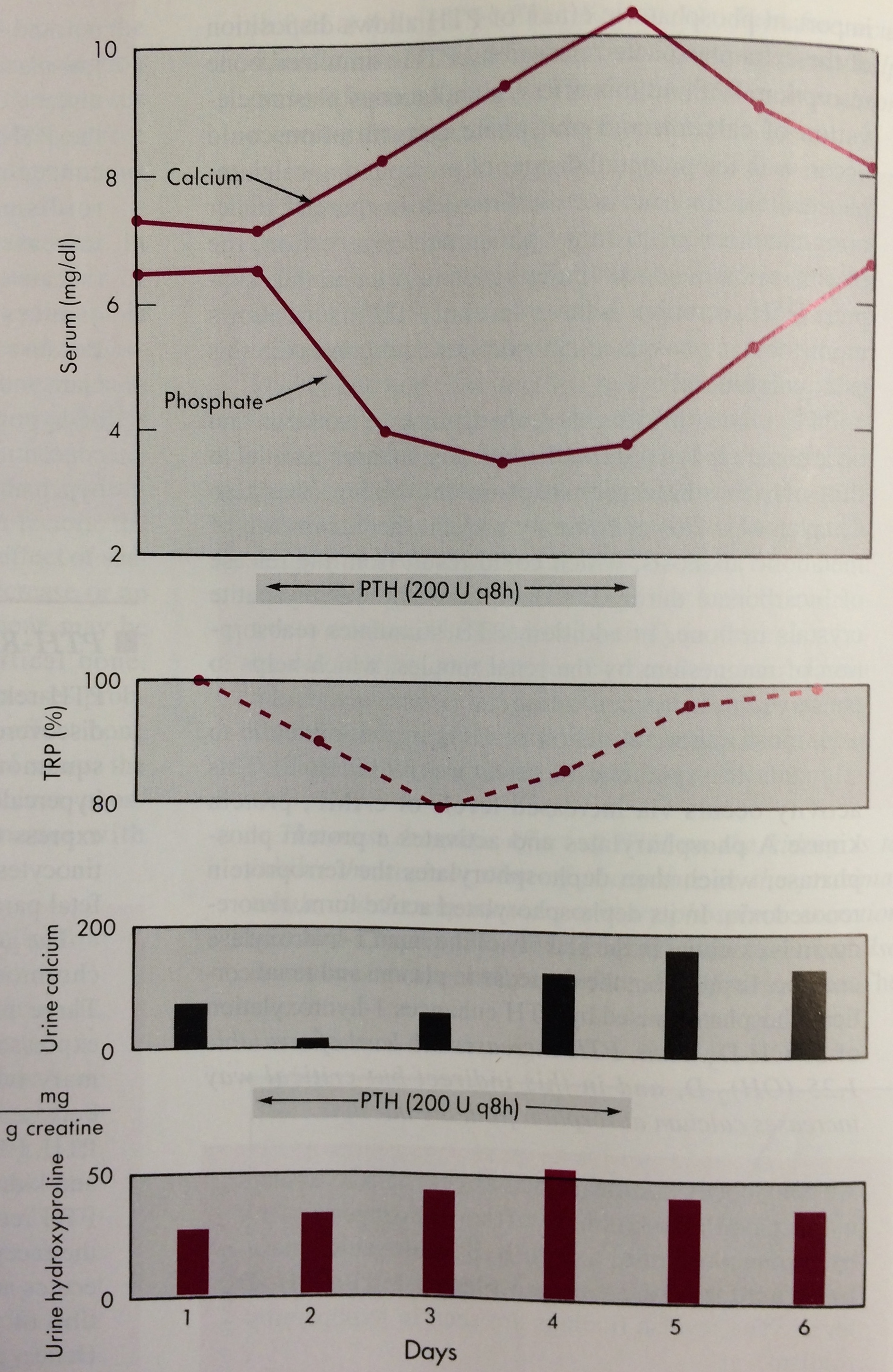
From “Physiology” by Berne and Levy (Fourth Edition)
The question refers to (blurry) Figure 6 in my Calcium and Phosphate Balance Lecture notes:
a. is the correct answer. PTH liberates Ca from bone by increasing both osteogenesis and osteolysis. It increases osteolysis more.
b. is incorrect. Vitamin D increases absorption of Ca from the gut. PTH does increase the formation of active vitamin D but note the word “directly” in the question stem.
c. is incorrect. PTH decreases phosphate reabsorption in the kidney.
d. is incorrect. Decreased plasma [Ca] decreases calcitonin secretion
e. is incorrect. In fact, PTH acts relatively rapidly upon the kidney cells, the reason why there is an initial dip in urinary [Ca] on day 2 after the PTH injection. Note that the urinary [Ca] rises after that due to the rise in plasma [Ca] and the increased glomerular filtration that results (see the notes for details).
I did not write this question and it is unlikely that I would try to throw you off by using the word “directly” in the question stem. If I did, I’d probably put it in bold or something. Nevertheless, I consider this figure to be relatively important and you should understand it.